Stocking a guest bathroom, a dental chair and a travel bag
Every room tells a story before a single word is spoken. In a short-term rental, the bathroom shelf is the chapter most guests read first, and they read it with their hands. They pick up the tube, turn it over, check the seal. They do the same with the toothbrush, the floss, the little bottle of mouthwash. What they are looking for is not a brand they recognize. They are looking for proof that the thing in their hand is new, that it was placed there for them, and that it has not been touched by anyone else. That proof is quiet, but it is loud enough to decide whether the room feels cared for or merely cleaned.
The same logic runs through a dental practice, a clinic reception desk, and a carry-on bag. The person on the other side of the counter is not a guest, but they are still a stranger. They are still entitled to an item that is sealed, that looks like it was meant for them, and that works on the first try. The small decisions make that possible: what to stock, how much to stock, and what to avoid, whether you are managing a property, running a practice, or packing for a week away. The goal is simple: put the right thing in the right place, and let the packaging do the talking.
What a guest actually notices
Guests do not notice the thread count or the brand of the soap as much as hosts hope. They notice whether the item in front of them is sealed. A sealed tube of toothpaste, a wrapped toothbrush, a floss spool with its band intact: these are the details that register. They register because they answer a question the guest did not ask out loud: is this safe to use? The seal is the answer.
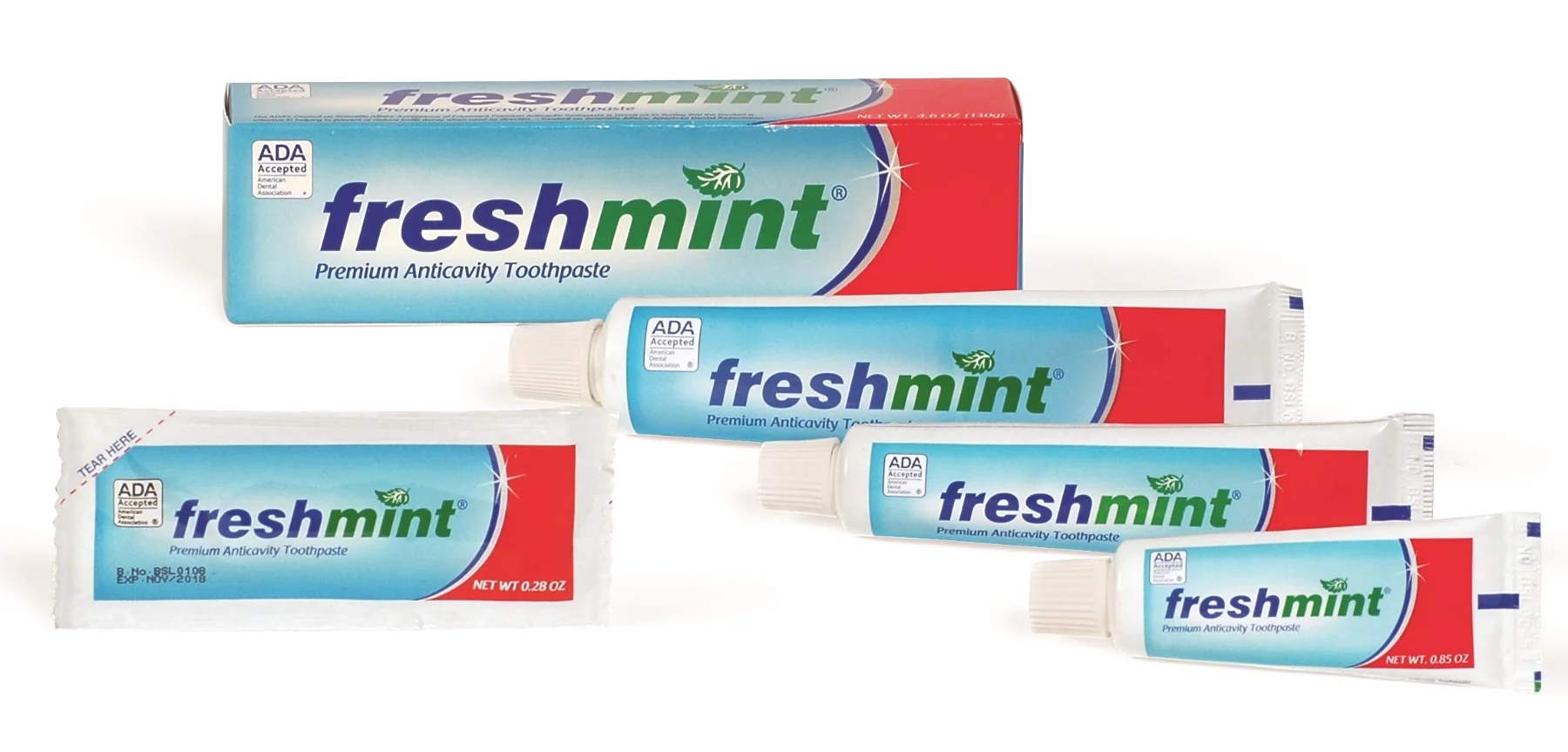
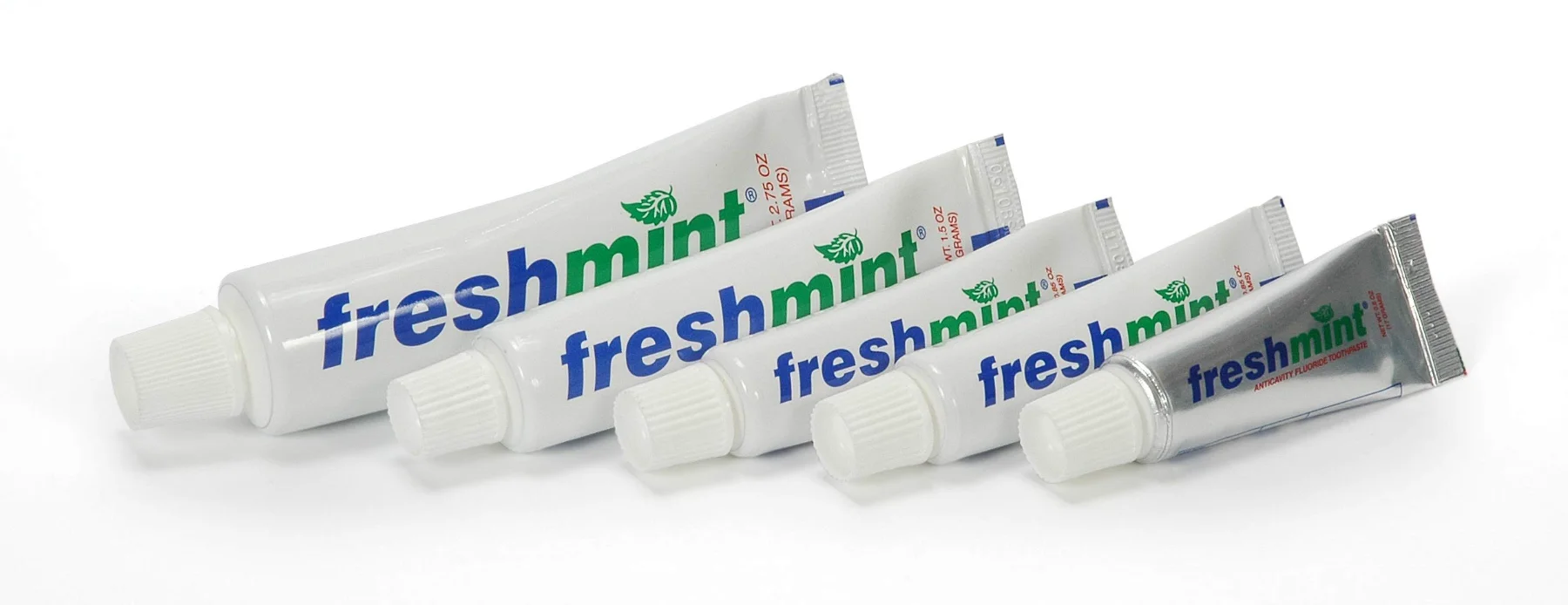
The second thing they notice is whether the item looks like it was meant for them. A full-size tube of toothpaste that has clearly been squeezed, rolled, and clipped is a signal that the item is communal property. A small tube, 0.85 oz or 1.5 oz, still in its box with the seal under the cap, looks like a personal provision. It looks like someone thought about the guest before the guest arrived. That is the feeling you are paying for when you buy the right size, and it is worth more than any logo.
The third thing they notice is whether it works. A toothbrush that is still in its wrapper works. A tube that opens cleanly works. A packet of floss that tears open at the notch works. The failure mode is not a broken product. The failure mode is a product that requires effort, scissors, or a search for the right end of the tape. When a guest has to work to use what you provided, they remember the friction, not the intention. Keep the friction at zero and the gesture lands.
Sealed against unsealed
The tamper-evident seal under the cap is the single most important detail in a guest bathroom. It is not about the toothpaste itself. It is about the message the seal sends. A sealed tube says that no one has opened it, used it, and put it back. An unsealed tube, even one that looks full, carries doubt. That doubt is not rational, but it does not need to be. It is enough to make a guest set the tube aside and use their own, or worse, leave a review about the state of the bathroom.
In your own bathroom, an unboxed tube is fine. You know where it has been. You know who used it last. The rules change in a rental or a hotel room, because the room is a shared space with a rotating population. An unboxed tube reads as leftover. A sealed tube reads as provision. The cost difference between the two is a few cents. The difference in perception is the difference between a room that feels managed and a room that feels abandoned.
The same principle applies to the toothbrush. A brush lying loose on the counter, even a new one, looks like it could have been used. A brush in its own sealed bag removes the question entirely. Our toothbrushes come individually wrapped in their own bag. There is nothing to cut, nothing to tear, and no ambiguity about whether the brush has been touched. One bag, one pull, and it is ready. That is the standard to hold in any room a stranger will use.
Wrapped toothbrushes
The individually wrapped toothbrush is a small piece of engineering that most people never think about. The wrapper has to be tight enough to stay sealed, but easy enough to open without a tool. Ours are designed to open with a single pull at the notch. No scissors, no teeth, no struggle. That matters at the front desk of a hotel, where a guest is tired and the line behind them is growing. It matters at the reception window of a clinic, where a patient is anxious and does not want to look foolish fumbling with a wrapper.
The wrapper also does the work of communication. A wrapped brush on the counter says "new" without a word. It is a visual guarantee. When you stock a room with wrapped brushes, you are not just providing a tool. You are providing evidence that the room has been turned over properly. That evidence is visible from the doorway, which is exactly where a guest first looks.
There is a practical side too. Wrapped brushes stack neatly, travel well, and stay clean in a drawer or a bin. They do not pick up dust or lint. They do not get mixed up with brushes that have been used. In a busy property, where turnover is fast and the margin for error is thin, the wrapper is the thing that keeps the system honest. One bag, one pull, nothing to cut, and the brush is in the guest's hand.
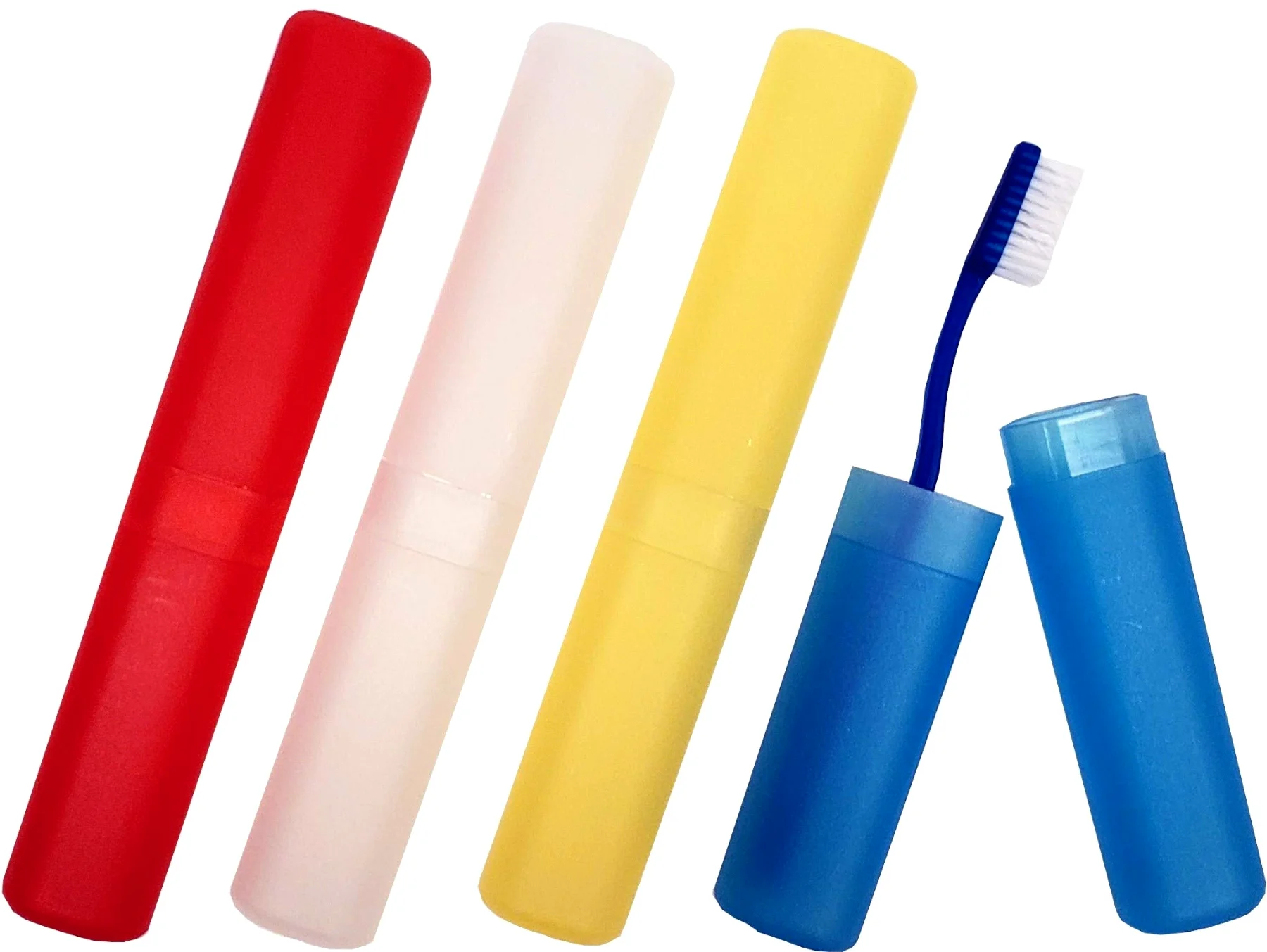
Travel case brush and two-piece brush
Not every toothbrush is the same, and the difference matters when space is tight. The travel case brush is the one that comes with a protective case, usually a hard shell that clicks shut. It is meant for someone who is going to throw the brush into a bag, a backpack, or a purse, and does not want the bristles touching anything else. The case keeps the brush clean and keeps the rest of the bag clean. It is the right choice for a guest who is moving between locations, or for a patient who is going to slip the brush into a pocket on the way out.
The two-piece brush is different. It is a brush that separates into two parts, with the head stored inside the handle. It is shorter when assembled, which makes it easier to pack. It does not need a separate case, because the head is protected by the handle itself. This is the brush for the traveller who counts every ounce and every inch. It is also the brush for someone who wants a full-size cleaning experience in a package that fits in a palm.
For a property manager, the choice depends on the guest. A short-term rental with a week-long stay might warrant the travel case brush, because the guest has space and will appreciate the case for the trip home. A hotel that hands out brushes at the front desk might prefer the two-piece, because it is smaller, lighter, and easier to store in bulk. Neither is wrong. They serve different moments, and stocking both gives you the flexibility to match the moment.
Formats for a dental practice take-home
A dental practice operates on a different rhythm than a hotel. The practice does not stock rooms for a rotating population of guests. It stocks a drawer, a cabinet, or a bin at the reception desk, and it hands items out to patients as they leave. The volume is higher, and the items are smaller. The goal is not to provision a room. The goal is to send a patient home with something useful.
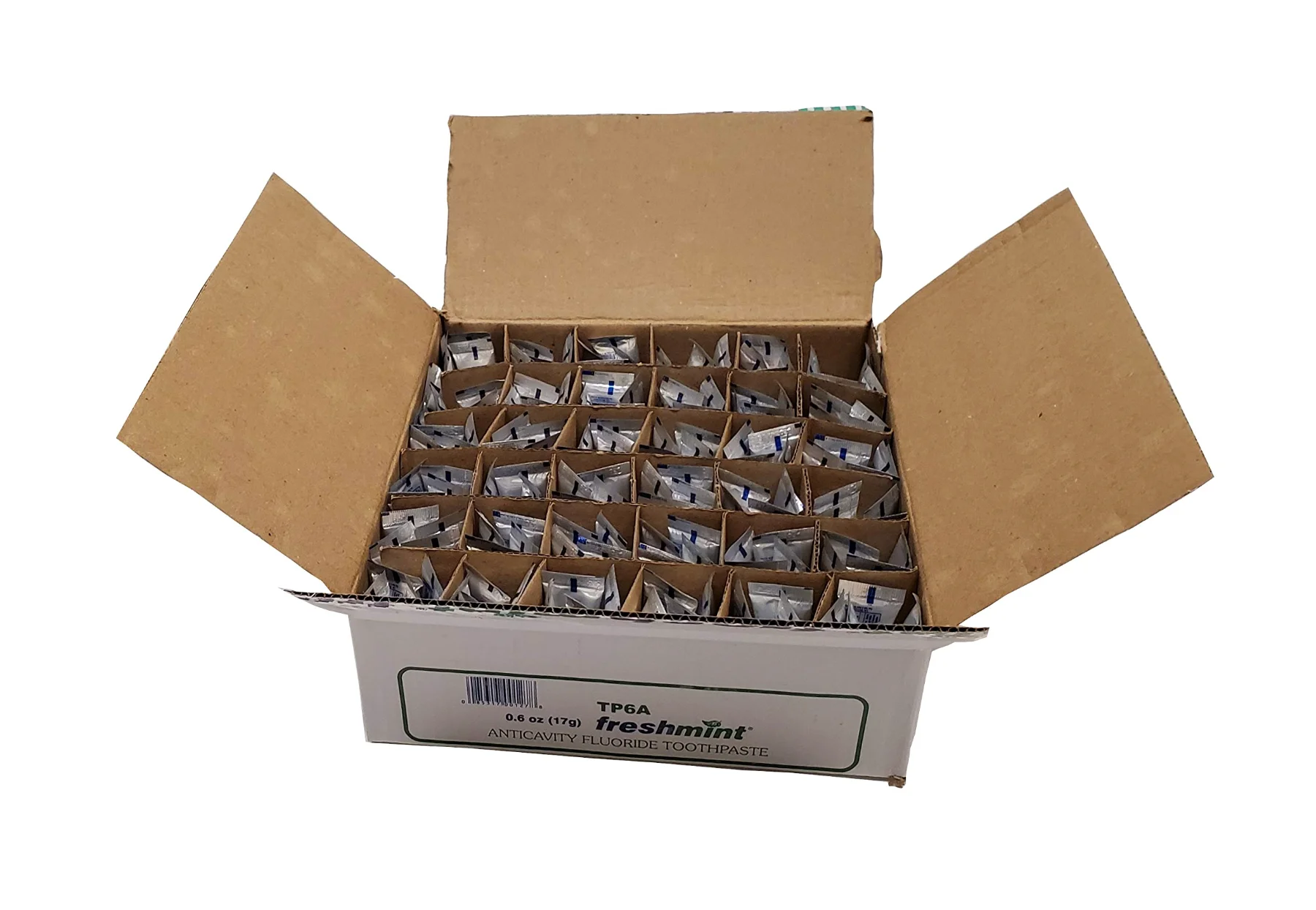
The small tube, 0.85 oz or 1.5 oz, is the workhorse of the take-home kit. It is big enough to last a few weeks, small enough to fit in a pocket, and sealed so that the patient knows it is new. The floss spool, 12 yards, is the natural companion. It is a single, self-contained unit that does not need a box. The packet, whether it is a single-use toothpaste packet or a small floss packet, is the lightest option. It is the one that a patient can slip into a purse or a coat and forget about until they need it.
| Setting | What to put out | Why that one |
|---|---|---|
| Short-term rental | Sealed 0.85 oz premium tube and a wrapped brush | A guest sees the seal before they see anything else |
| Small hotel room | Sealed 1.5 oz premium tube and a wrapped brush | Lasts a longer stay without a second hand-out |
| Dental practice take-home | 1.5 oz tube, a wrapped brush and a floss spool | The drawer goes out faster than the chair uses it |
| Clinic or ward | 0.28 oz sealed packets and wrapped brushes | Nothing is shared, nothing is stored open |
| Office washroom | Single-use packets | One brushing at a time, no tube to own |
| Travel bag | 0.6 oz tube or packets, two-piece brush, 2 oz rinse | Everything clears the liquids rule and the brush folds away |
The key insight for a practice is that it hands out far more than it uses. The chairs in the operatory might go through a tube a day. The take-home drawer goes through a dozen tubes a morning. That is why the case counts matter. Our packets come in cases of 144, 250, 500 and 1,000. The small tubes come in cases of 144. When you order at that scale, the cost per item drops, and the practice can afford to be generous. Generosity is not a cost. It is the thing that makes a patient remember the practice between visits.
Airport rules and small bottles
The rules for carry-on liquids are simple, and they are unforgiving. Containers must be 3.4 oz (100 ml) or less, and they must fit in a single quart-sized bag. Our mouthwash bottle is 2 oz. That is under the limit, which means it can go in a carry-on without a second thought. The small tubes, 0.85 oz and 1.5 oz, are also under the limit. The packets are not liquids at all, so they clear security without any inspection.
For the frequent traveller, the size is the point. A 2 oz bottle of mouthwash is enough for a week of rinsing. A 0.85 oz tube of toothpaste is enough for the same. The two-piece brush takes up almost no room. The floss spool is flat. The whole kit fits in a quart bag with room to spare, which means the traveller can also carry a shampoo, a conditioner, and a deodorant without having to check a bag.
The other advantage of small bottles is that they do not leak, or rather, they are less likely to cause a problem if they do. A full-size bottle of mouthwash that bursts in a bag ruins everything. A 2 oz bottle that bursts is a minor inconvenience. The small size is not just a convenience for the airport. It is a risk management tool for the bag itself.
Quantities and case counts
The math of stocking is simple, but it requires a habit of rounding up. The calculation starts with turnovers. A turnover is one guest, one stay, one use. For a property, that might be one tube and one brush per guest. For a practice, that might be one tube and one floss spool per patient. The question is how many turnovers you need to cover between orders.
Our brushes come in cases of 100 and 144. Our tubes come in cases of 144. If you have 40 turnovers a month, a case of 144 tubes covers more than three months. If you have 100 turnovers a month, a case of 100 brushes covers exactly one month, and you should order the next case before you run out. The rule is to always round up to the next full case. A partial case is not a problem. An empty drawer is.
| Turnovers a month | Tubes needed | Brushes needed | Case to order |
|---|---|---|---|
| 5 | 5 | 5 | 1 case of 144 tubes, 1 case of 100 brushes |
| 10 | 10 | 10 | 1 case of 144 tubes, 1 case of 100 brushes |
| 20 | 20 | 20 | 1 case of 144 tubes, 1 case of 100 brushes |
| 40 | 40 | 40 | 1 case of 144 tubes, 1 case of 144 brushes |
The table assumes one tube and one brush per turnover. If you give out floss as well, add that to the count. If you give out packets instead of tubes, the case counts change, and you can order packets in 144, 250, 500 or 1,000. The habit of rounding up to the next case is the one that keeps the drawer full.
Storage
Storage is the part of stocking that no one thinks about until it goes wrong. A case of 144 tubes takes up about the same space as a ream of paper. It fits on a standard shelf, or in a cupboard, or under a counter. A case of 100 brushes is slightly smaller. Nothing here needs refrigeration, which means the storage options are wide open. A closet, a pantry, a cabinet under the sink: all of them work.
The small tubes survive a cupboard because they are small. They do not crush, they do not spill, and they do not go bad. The packets are even easier. They are flat, they stack, and they take up almost no room. A box of 500 packets fits in a drawer. A box of 1,000 fits in a small box on a shelf.
The one rule of storage is visibility. If you cannot see it, you will not use it, and you will not reorder it. Keep the cases where you can see them. Keep a small amount in the room or at the desk, and the bulk in the storage area. When the small amount runs low, you know it is time to restock from the case. When the case runs low, it is time to order. The system only works if the stock is visible.
Cost per turnover
The cost per turnover is the number that matters, and it is easy to calculate. Take the case price and divide it by the count. A case of 144 tubes at a given price works out to a cost per tube. A case of 100 brushes works out to a cost per brush. The per-item cost is what you compare when you are deciding between sizes or formats.
The small sizes are not just cheaper per item. They are cheaper per turnover, because they are the right size for the job. A 0.85 oz tube is enough for a guest stay or a patient take-home. A full-size 4.3 oz tube is not. If you buy the full-size tube for a guest room, the guest will use a little, take the rest, or leave it half-used. The half-used tube is waste. The small tube is not.
The same logic applies to the brush. A wrapped brush costs a few cents. It is a one-time item, and it is gone with the guest. The cost is not a line item. It is the price of the message that the room is ready. When you work out the cost per turnover, the small sizes always win, because they match the scale of the need.
What not to do
There are a few practices that undo all the good work of stocking. The first is refilling. Refilling a bottle of mouthwash, a pump of soap, or a tube of anything is a risk. You do not know what is in the container, you do not know how it was handled, and you cannot guarantee its integrity. The moment you refill, you lose the seal, and the seal is the thing that makes the guest trust the item.
The second is decanting into unlabelled containers. A guest should never have to guess what is in a bottle. If it is not in its original packaging, it does not belong in a guest room or a practice take-home. The label is not just information. It is the assurance that the product is what it says it is.
The third is handing out an opened tube. An opened tube, even one that was opened by a staff member who is healthy, is a liability. The guest does not know the history. The guest only knows that the seal is broken. Throw it away. The cost of a new tube is cents. The cost of a guest's doubt is higher.
The routine itself
The routine is simple, and it comes from national health guidance. Brush twice a day with a fluoride toothpaste. Clean between the teeth once a day with floss or an interdental cleaner. See a dentist once a year for a check-up. That is the whole routine, and it is the one that all of these products support.
A room gets a sealed tube and a wrapped brush, and anything that has been opened goes in the bin. We order in full cases and we round up, so the drawer is never empty when a guest or a patient needs it.
The products in this catalogue are the tools for that routine. The toothpaste, the brush, the floss, the mouthwash: each one has a place in the routine, and each one works best when it is new, sealed, and sized for the moment. Whether you are stocking a guest bathroom, a dental chair, or a travel bag, the principle is the same. Provide the right tool, keep it sealed, and let the guest or the patient take it from there. Freshmint makes that easy, because the sizes are right, the cases are practical, and the seals are intact. The routine is the habit. The products are the support. The result is a room that feels ready, a practice that feels generous, and a traveller who is prepared. That is the whole job.
Everything named here sits in Freshmint bulk oral care, on the toothbrushes shelf and the seven beside it.